

Article by
Lee and Stuart
Lee Stancer & Stuart Allen – Kobb Interiors Ltd
Lee Stancer and Stuart Allen are the directors of Kobb Interiors Ltd, a Harrogate-based interiors company specialising in the design and installation of bespoke kitchens, bedrooms, home offices, and shutters. With a shared passion for craftsmanship and modern, thoughtfully designed spaces, they combine creative vision with practical expertise to deliver high-quality, tailored interiors.
Lee focuses on design, client experience, and brand direction, bringing a warm, contemporary style to each project. Stuart complements this with strong technical knowledge and project delivery, ensuring every detail is executed to the highest standard.
Together, they have built Kobb Interiors into a trusted destination showroom, offering premium products including solid surfaces as a Cosentino Elite partner, as well as leading appliance, tap, and furniture solutions. Their collaborative approach ensures every space is both beautiful and functional, designed to enhance the way their clients live.
The most profound architectural decision for a modern home often begins with a single, quiet choice: how you intend to cook. When weighing induction vs gas hobs for bespoke kitchens, the conversation has shifted from simple heat output to the pursuit of a seamless, tactile sanctuary. You might find yourself lingering on the familiar, visceral glow of a gas flame, yet worrying if a sleek surface will withstand the rigours of a busy Yorkshire home without scratching your chosen Silestone or Dekton worktops. We understand that a kitchen is more than a workspace; it is a carefully curated environment where every texture and line must serve a purpose.
This 2026 guide reveals how modern induction technology provides the architectural freedom and minimalist elegance required for a high-performance retreat. You will discover how to achieve a flush-fitted look across your kitchen island without compromising on the professional control you require. We will explore the precision of integrated venting hobs, the effortless maintenance of glass surfaces, and the remarkable energy efficiency that ensures your home remains as sustainable as it is beautiful. By the end, you will have the clarity needed to select a culinary centrepiece that balances heritage with modern functionality.
Key Takeaways
- Understand how the architectural freedom of induction technology supports a minimalist aesthetic, allowing for a flush-fitted finish that complements bespoke cabinetry.
- Explore the technical advantages of "Bridge" functions and integrated ventilation, which eliminate the need for traditional overhead extractors in open-plan island designs.
- Learn why the choice between induction vs gas hobs for bespoke kitchens in 2026 is centred on creating a high-performance sanctuary rather than just raw heat output.
- Discover how to pair premium AEG and Smeg appliances with Silestone or Dekton worktops to ensure both visual harmony and long-term surface durability.
- Gain insight into the importance of professional project management when integrating complex electrical and stone elements into your North Yorkshire home.
The Evolution of the Culinary Sanctuary: Why Induction Leads in 2026
The kitchen has transitioned from a site of mere utility into a curated sanctuary. It is a space where the tactile qualities of timber and stone meet the silent precision of high-performance engineering. In North Yorkshire, we're seeing a significant shift in how homeowners approach the debate of induction vs gas hobs for bespoke kitchens. While gas once held the crown for professional control, the 2026 design landscape honours the "uninterrupted horizon." This philosophy prioritises clean lines and a seamless flow across the kitchen island, allowing the architecture of the room to breathe without the visual interruption of heavy iron pan supports. It's about balancing the emotional warmth of traditional 1909 cabinetry with a surface that feels light, modern, and intentional.
How Modern Induction Technology Works
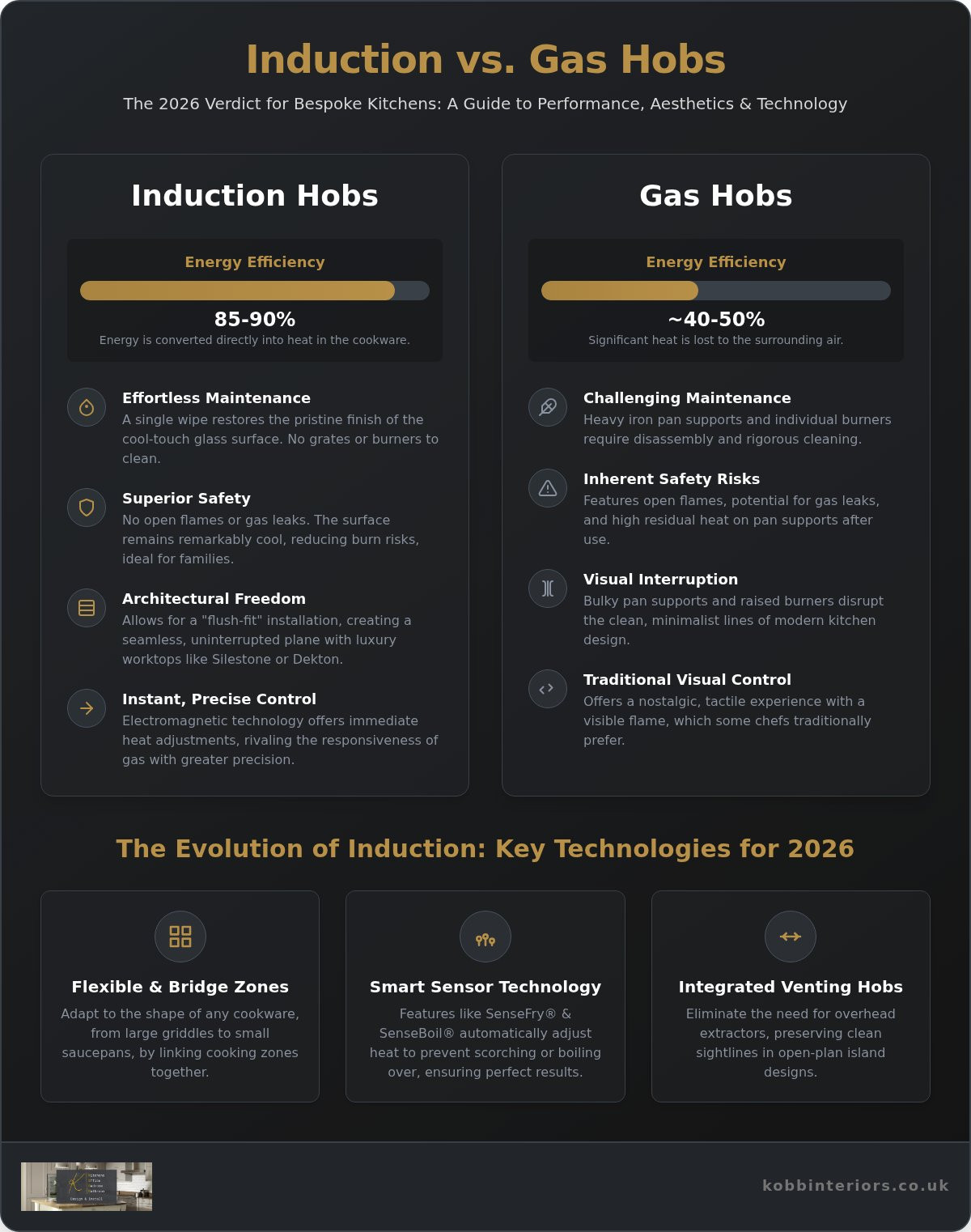
At its core, an induction hob functions as a precision electromagnetic engine. Unlike traditional methods that heat a ring or a flame, this technology uses magnetic friction to turn the cookware itself into the heat source. You can explore the technical details of how induction cooking works to understand why the glass surface remains remarkably cool to the touch. For a bespoke sanctuary, this means energy efficiency is built into the very fabric of the home. Induction models are significantly more efficient than gas, converting 85-90% of energy directly into heat. Modern sensors in premium AEG and Smeg appliances now offer a level of responsiveness that rivals the tactile nature of a gas flame, providing immediate control for delicate reductions or rapid boiling.
Induction vs. Gas: The Final Verdict for New Kitchens
The decision often rests on the equilibrium between physical structure and emotional impact. For multi-generational homes in Harrogate and Ripon, safety is a quiet but vital luxury. Induction hobs eliminate the risk of open flames and high residual heat, offering peace of mind in a busy household. Visually, the "flush-fit" advantage allows the hob to sit perfectly level with Silestone or Dekton surfaces, creating a singular, tactile plane. Maintenance becomes a moment of serenity rather than a chore. A single wipe restores the pristine finish of the glass, ensuring the kitchen remains a calm, uncluttered space throughout the day. While gas retains a nostalgic charm, the architectural liberation offered by induction makes it the definitive choice for the modern, high-performance home.
Technical Excellence: Key Features for Your Bespoke Project
Selecting the right appliance is an exercise in discerning technical capability from merely decorative features. For those debating induction vs gas hobs for bespoke kitchens, the choice often hinges on how a hob accommodates the scale of your culinary ambitions. While a standard 60cm hob serves smaller footprints, expansive 90cm professional zones provide the breathing room required for complex menus. These larger surfaces don't just add space; they introduce a sense of calm to the cooking process, allowing multiple pans to simmer without crowding the visual field.
Advanced sensory technology now acts as a silent partner in the kitchen, reducing the mental load of meal preparation. Systems like AEG's SenseFry and SenseBoil provide intuitive support that prevents common kitchen stresses:
- SenseFry: This system maintains an even temperature across the pan surface to ensure consistent browning without scorching.
- SenseBoil: Smart sensors detect rising bubbles and automatically adjust the heat to a controlled simmer before a spill occurs.
This automation extends to smart connectivity, where the hob communicates directly with your extraction system to manage lighting and fan speeds instinctively. Beyond convenience, these systems contribute to significant energy efficiency and air quality benefits, ensuring your home remains a healthy, refined environment.
Precision Control and Flexi-Zones
Flexible zones are designed to adapt to the organic shapes of artisan cookware rather than forcing you to fit a pan to a pre-defined circle. The tactile experience is elevated through modern slide-to-control touch interfaces, allowing for fluid adjustments with a single, steady hand. Bridge Zones allow you to link two separate cooking areas to create one continuous surface for oversized platters or long griddle pans. This adaptability ensures your culinary hub remains as versatile as the bespoke cabinetry surrounding it.
The Durability of SaphirMatt and Premium Glass
One common hesitation involves the longevity of glass surfaces. AEG's SaphirMatt finish addresses this directly, offering a matte texture that is significantly more scratch-resistant than standard ceramic glass. This unique surface aligns with kitchen design trends 2026, where low-sheen materials are favoured for their ability to reduce glare in bright, airy rooms. When evaluating induction vs gas hobs for bespoke kitchens, this durability ensures your investment maintains its lustre for decades. This matte aesthetic creates a beautiful dialogue with the hand-painted finishes of 1909 cabinetry, ensuring your appliances feel like a deliberate part of the craftsmanship. If you're ready to refine your vision, you can explore our curated appliance range to see how these elements integrate into a full project.
Design Synergy: Integrating Hobs with Luxury Worktops
The visual dialogue between an appliance and its surrounding surface defines the serenity of a high-end space. When considering induction vs gas hobs for bespoke kitchens, the decision is often guided by the desire for a cohesive, architectural finish. Gas hobs, with their raised cast-iron supports, create a physical barrier across the worktop that can feel cluttered in a minimalist design. In contrast, the sleek, obsidian plane of an induction surface allows for a continuous visual horizon. This harmony is particularly striking when paired with Silestone or Dekton surfaces, where the glass and stone meet in a quiet, sophisticated union.
The choice of colour composition plays a vital role in the emotional resonance of the room. Deep, midnight-black glass can be used to anchor a dark quartz island, creating a monochromatic statement of quiet power. Alternatively, placing a dark hob against a marble-effect surface provides a sharp, modern contrast that highlights the natural veining of the stone. Beyond aesthetics, a U.S. Department of Energy analysis highlights how these systems offer superior energy efficiency and improved indoor air quality, ensuring your sanctuary remains as healthy as it is beautiful.
The Flush-Fit Aesthetic
For a truly minimalist luxury finish in Harrogate homes, flush-mounting is the preferred approach. This technique involves recessing the hob into a precisely routed rebate within the solid surface, achieving a "zero-bezel" look where the glass sits perfectly level with the stone. It requires meticulous craftsmanship and expert stone-cutting to ensure the transition is seamless. This level of detail preserves the tactile flow of a bespoke kitchen in Harrogate, allowing your hand to glide across the surface without catching on a raised edge. It transforms the hob from a functional tool into an integrated architectural element.
Materiality and Texture
The interplay of light across different textures adds depth to a bespoke design. There is a refined beauty in how the cool, polished touch of induction glass complements the organic, matte feel of natural stone or high-performance Dekton. In North Yorkshire projects, we often design the hob as the social centrepiece of a kitchen island. Because the surface stays relatively cool, the island remains a safe, inviting space for guests to gather while the host prepares a meal. Designing for longevity requires this level of expert integration; high-end stone is an investment that deserves the precision of a perfectly fitted, premium appliance.
The Venting Hob Revolution: Freedom from the Extract Hood
Open-plan living in bespoke property extensions across our Yorkshire service area demands a layout that fosters connection rather than isolation. Traditional overhead extractors often act as a visual barrier, bisecting a room and obscuring the sightlines that make a bespoke space feel expansive. The venting hob represents a fundamental shift in kitchen architecture. By integrating the extraction directly into the induction surface, we remove the need for bulky hoods, allowing for a cleaner, more minimalist silhouette. When comparing induction vs gas hobs for bespoke kitchens, this integrated ventilation is often the deciding factor for those seeking a truly liberated floor plan that doesn't sacrifice performance.
The question of whether a downdraft can truly handle heavy steam and intense aromas is a common one. Modern systems are engineered with high-velocity motors that capture vapours at the source, pulling them down before they have the chance to linger in the air. This ensures that the delicate fabrics and textures of your living area remain protected from the physical remnants of cooking. It is a quiet, powerful solution that respects the sensory balance of a high-end home.
Downdraft Technology Explained
Integrated systems operate on the principle of pulling steam directly from the pan's edge. Depending on the structural constraints of your specific Yorkshire property, these units can be configured for either ducting or recirculation. Ducting carries air to an external wall, while recirculation uses advanced carbon filters to scrub the air and return it to the room. Both methods are highly effective at maintaining pristine air quality. This flexibility allows us to place a cooking zone on an island in a period property where ceiling-mounted ducting would be impossible or unsightly.
Designing an Island with a Venting Hob
An island is the social heart of the home, and a venting hob preserves its role as a sanctuary for entertaining. Without an overhead fan, conversation flows naturally across the counter, and feature lighting can take centre stage without competition. It's vital to consider how these units interact with your internal cabinetry, as the motor and ducting will occupy some space within the drawers below. However, through thoughtful project management, we ensure that storage remains generous and functional. You can explore specific AEG appliances in Harrogate to see how these venting models integrate into our custom cabinetry designs.
If you're ready to design a kitchen that prioritises architectural clarity and social connection, speak with our Harrogate design team to begin your journey.
The Kobb Interiors Approach: Professional Selection and Installation
At Kobb Interiors, we believe that the choice of appliances is never a secondary detail. It is a core pillar of the design process. When evaluating induction vs gas hobs for bespoke kitchens, our role is to provide the steady hand and seasoned expertise required to make a discerning choice. We have curated partnerships with premium brands like AEG and Smeg because their engineering mirrors our commitment to understated elegance. These are not just tools; they're the silent engines of your home. We invite you to our Harrogate showroom to experience the tactile quality of these surfaces firsthand, allowing the materials to tell their own story through a sensory exploration of form and function.
Full Project Management in North Yorkshire
Managing the intricacies of a modern kitchen requires a comprehensive vision. Integrating a high-performance induction hob into a solid stone worktop involves more than just a simple cutout. It requires the seamless coordination of specialist electricians, stone masons, and our own master cabinet makers. Our project management ensures that your 1909 or Second Nature kitchen is fully future-proofed for 2026 technology and the innovations that will follow. We handle the technical complexities of electrical loads and precision stone routing so you can focus on the emotional resonance of your new sanctuary. To begin this collaborative process, you can Contact Kobb Interiors for a personalised consultation.
Flexible Finance for Your Luxury Renovation
A luxury renovation is a significant investment in the longevity and daily rhythm of your home. Choosing premium appliances as part of a full kitchen project ensures that every element is built to endure, maintaining its performance and aesthetic appeal for decades. Our finance options are designed to facilitate these comprehensive projects, allowing you to prioritise quality and craftsmanship without compromise. Investing in high-end hobs is a long-term strategy for home improvement that adds genuine value to your property.
Expert installation is vital to this process. It preserves the manufacturer’s warranty and ensures that your appliance functions with the exact precision intended by the engineers at AEG or Smeg. With over 40 years of industry experience, we understand that the equilibrium between physical structure and emotional impact is found in the meticulous details of the execution. We don't just supply a kitchen; we manage a transformation that respects both heritage and modern living.
Defining the Future of Your Culinary Sanctuary
Choosing between induction vs gas hobs for bespoke kitchens is ultimately a decision about how you wish to inhabit your home. It's the balance between the visceral tradition of a flame and the serene, architectural clarity of a flush-fitted surface. We've explored how 2026 technology enables an uninterrupted workspace, where integrated extraction removes visual clutter and precision sensors manage the intricacies of heat. Whether you prefer the tactile warmth of a 1909 design or the minimalist edge of a modern extension, the right appliance acts as the silent heart of the room.
At Kobb Interiors, we bring over 40 years of Yorkshire craftsmanship to every project. We specialise in the expert integration of AEG and Smeg appliances into high-performance Silestone and Dekton worktops. Our approach ensures that technical excellence never compromises the emotional resonance of your space. It's about more than just installation; it's about curated harmony.
Begin your journey toward a bespoke culinary sanctuary and discover how our personalised project management can transform your vision into a lasting reality. Your sanctuary awaits.
Frequently Asked Questions
Do I need special pans for an induction hob in 2026?
You require cookware with a magnetic base, such as cast iron or stainless steel, to facilitate the electromagnetic connection. Most high-end artisan pans now include a ferrous layer. You can easily check your current collection with a simple magnet; if it sticks firmly to the base, the pan will work. This transition is often simpler than expected when choosing between induction vs gas hobs for bespoke kitchens, as many professional-grade sets are already induction-ready.
Can an induction hob be installed in an old Yorkshire period property?
Absolutely. While period homes in North Yorkshire may have older wiring, our full project management service includes coordinating specialist electricians to upgrade your infrastructure. We ensure the electrical load is managed safely while preserving the architectural integrity of your property. Integrating modern technology into a heritage setting creates a beautiful equilibrium, allowing you to enjoy 2026 performance within a space that still honours its traditional roots and historic character.
Are induction hobs noisier than gas or electric hobs?
Induction hobs produce a subtle, low-frequency hum caused by the electromagnetic coils, along with a quiet cooling fan. These sounds are generally unobtrusive and vary depending on the power level and the quality of your cookware. Premium models from AEG and Smeg are engineered for quiet operation, ensuring your kitchen remains a serene sanctuary. Compared to the hiss of a gas flame or the rattle of traditional extractors, the acoustic profile is remarkably refined.
What happens if I scratch the glass on my new induction hob?
While the ceramic glass is incredibly durable, it can be susceptible to scratches from abrasive cleaning or dragging heavy pans. Minor marks can sometimes be treated with specialist polishing compounds, but deep scratches are permanent. To avoid this concern, we often recommend AEG SaphirMatt finishes, which are up to four times more scratch-resistant than standard glass. This choice is a vital consideration when weighing induction vs gas hobs for bespoke kitchens to ensure long-term visual harmony.
How much power does an induction hob require, and do I need a new circuit?
Most full-sized induction hobs require a dedicated 30-amp or 32-amp circuit, which is higher than a standard 13-amp plug socket. During our design process, we assess your home’s existing consumer unit to determine if a new dedicated cable is required. This technical requirement is a standard part of our installation service. We ensure all electrical work is certified and future-proofed, providing the necessary power for high-performance cooking without compromising the safety of your home.
Is a venting hob as effective as a traditional extractor hood?
Yes, modern venting hobs are exceptionally effective at capturing steam and grease directly at the pan’s edge. By pulling vapours downwards before they can rise, they prevent odours from lingering in open-plan living areas. These systems are particularly beneficial for kitchen islands, as they eliminate the need for a bulky overhead extractor. This allows for clear sightlines and a more social atmosphere, which is essential for the architectural freedom expected in a bespoke Yorkshire extension.
Can I use an induction hob if I have a pacemaker?
Because induction hobs generate an electromagnetic field, it is essential to consult your medical professional or pacemaker manufacturer before use. Most healthcare providers recommend maintaining a distance of at least 60cm between the hob and your device while cooking. While the technology is safe for the majority of users, this precaution ensures there is no interference with the settings of your pacemaker. Your safety and peace of mind are always our primary considerations.
Will an induction hob fit into my existing Shaker-style island?
Yes, the sleek profile of an induction hob is remarkably versatile and can be integrated into traditional Shaker-style islands with ease. Whether you have chosen 1909 cabinetry or a Second Nature design, we can create a custom cutout that allows the hob to sit flush or surface-mounted. This combination of heritage joinery and modern glass creates a sophisticated contrast, ensuring your kitchen island remains a functional, high-performance centrepiece within a classic aesthetic.
Finance Available
* Kobb Interiors Ltd is an Introducer Appointed Representative of Ideal Sales Solutions Ltd, t/a Ideal4Finance. Ideal Sales Solutions Ltd is a credit broker and not a lender (FRN 703401). Finance available subject to status. The rate offered is always provisional and will depend upon your personal circumstances, the loan amount and the term.


