

Article by
Lee and Stuart
Lee Stancer & Stuart Allen – Kobb Interiors Ltd
Lee Stancer and Stuart Allen are the directors of Kobb Interiors Ltd, a Harrogate-based interiors company specialising in the design and installation of bespoke kitchens, bedrooms, home offices, and shutters. With a shared passion for craftsmanship and modern, thoughtfully designed spaces, they combine creative vision with practical expertise to deliver high-quality, tailored interiors.
Lee focuses on design, client experience, and brand direction, bringing a warm, contemporary style to each project. Stuart complements this with strong technical knowledge and project delivery, ensuring every detail is executed to the highest standard.
Together, they have built Kobb Interiors into a trusted destination showroom, offering premium products including solid surfaces as a Cosentino Elite partner, as well as leading appliance, tap, and furniture solutions. Their collaborative approach ensures every space is both beautiful and functional, designed to enhance the way their clients live.
Could the daily rituals you use to polish your kitchen be the silent architects of its decline? It's a common concern for homeowners in North Yorkshire, where the high mineral content of our local water often leaves a cloudy veil of limescale over even the most exquisite surfaces. Mastering quartz worktop cleaning and maintenance is about more than simple hygiene; it's an act of preservation that honours the material quality of your home. You've likely felt the frustration of conflicting online advice, where one source recommends a solution that another warns will permanently dull the polished finish of your investment.
We believe that a bespoke kitchen should serve as a lasting sanctuary, and maintaining its lustre is essential to protecting a feature that can add up to 15% to your property's value. This guide provides a definitive path through the complexities of modern stone care. You'll discover a refined daily cleaning ritual tailored for high-end environments and gain the expert knowledge needed to remove stubborn stains without risk. We'll show you how to balance functional utility with aesthetic grace, ensuring your quartz remains a testament to timeless craftsmanship for years to come.
Key Takeaways
- Understand the unique composition of your surfaces to appreciate why a non-porous finish is the foundation of a hygienic, high-end kitchen.
- Adopt a rhythmic "wipe as you go" philosophy to simplify your quartz worktop cleaning and maintenance, using soft microfibre tools to preserve the original polish.
- Learn how to combat the specific challenges of North Yorkshire’s hard water by preventing the mineral haze that often clouds darker stone textures.
- Master the delicate poultice method to safely lift stubborn organic marks without compromising the integrity of the resin-bound surface.
- Discover how your choice of texture, from honed to leathered, influences long-term care and the enduring resale value of your luxury home.
Understanding Quartz Surfaces: Why Bespoke Care Matters
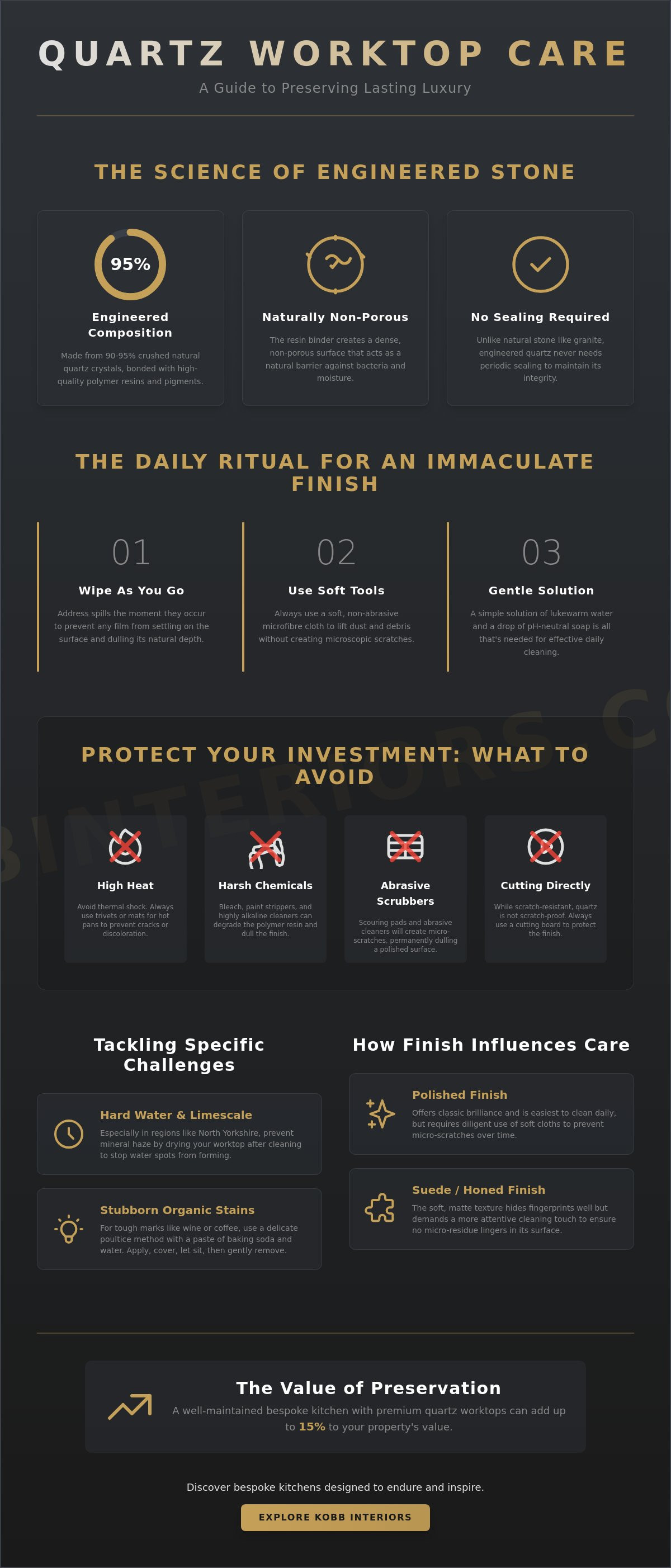
A premium kitchen is an investment in both lifestyle and legacy. When selecting materials, many homeowners choose engineered quartz surfaces for their marriage of resilience and refined beauty. Unlike natural granite, which is hewn directly from the earth, quartz is a sophisticated composite. It typically consists of 90-95% crushed natural quartz crystals bonded together with high-quality polymer resins and pigments. This composition creates a surface that is remarkably dense and entirely non-porous, offering a level of consistency that natural stone cannot achieve.
This lack of porosity is where the true luxury of the material lies. It serves as a natural barrier against bacteria and moisture, making it an inherently hygienic choice for a busy family home. However, because of the polymer resins, quartz worktop cleaning and maintenance requires a different intellectual approach than caring for natural stone. While granite might require periodic sealing to block its pores, quartz relies on the integrity of its resin binder to maintain its lustre. Traditional stone cleaners designed for porous materials often contain chemicals that can slowly etch or cloud these resins, turning a vibrant surface dull over time. Preservation is about protecting that chemical bond and the meticulous craftsmanship that went into the material's creation.
To better understand the nuances of caring for these refined surfaces, watch this helpful video:
The Science of Resin-Bound Surfaces
The resins that hold the quartz together are sensitive to extreme environmental shifts. High heat can cause thermal shock, potentially leading to fine cracks or discolouration if a boiling pan is placed directly on the surface. Similarly, common household chemicals like bleach, paint strippers, or highly alkaline cleaners can degrade the polymer finish. True preservation involves avoiding these harsh interactions to protect the material's structural narrative. It's a matter of respecting the craftsmanship of the surface and understanding that its beauty is maintained through subtle, consistent care rather than aggressive intervention.
Silestone vs. Standard Quartz: What Changes?
Market leaders like Silestone have elevated the medium, offering a range of tactile experiences that go beyond the traditional. Whether you prefer the classic brilliance of a Polished finish or the soft, organic touch of a Suede texture, each requires a slightly different hand. Exploring the curated collections at Kobb Interiors Ltd Kitchens reveals how these material choices define the atmosphere of a room. A Suede finish might hide fingerprints better in a sun-drenched Harrogate kitchen, yet it demands a more attentive touch during your quartz worktop cleaning and maintenance rituals to ensure no micro-residue lingers in its subtle texture. Every finish tells a story, and its preservation ensures that story remains clear for years to come.
The Daily Ritual: Maintaining an Immaculate Finish
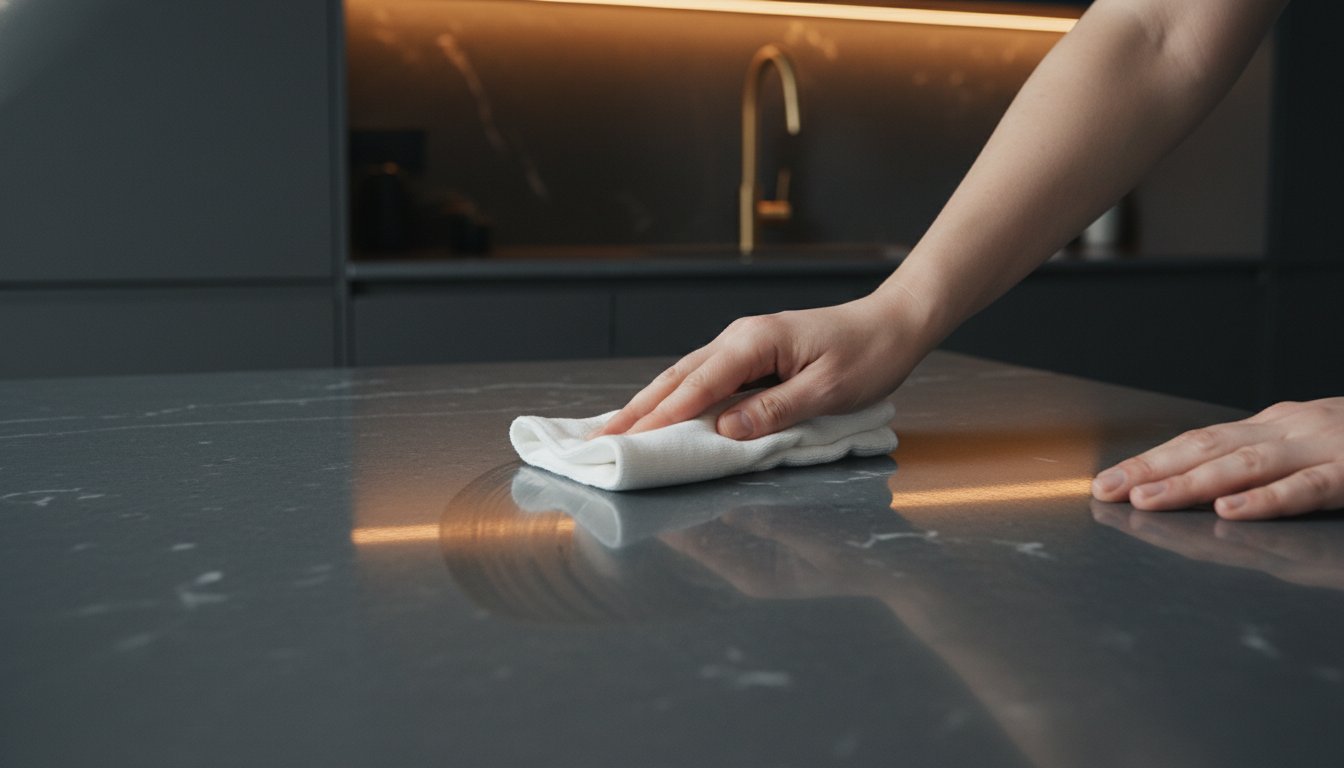
A luxury kitchen is more than a culinary space; it's a sanctuary of tactile experiences and visual harmony. To preserve this atmosphere, the philosophy of quartz worktop cleaning and maintenance must shift from reactive scrubbing to a rhythmic, daily ritual. The most effective approach is the "wipe as you go" method. By addressing spills the moment they occur, you prevent organic pigments from lingering on the surface. While quartz is non-porous, allowing liquids to settle can lead to a stubborn film that obscures the stone's natural depth.
Selecting your instruments is the first step in this quiet process of preservation. Soft, non-abrasive microfibre cloths are essential. They lift dust and debris without the risk of creating the microscopic scratches that eventually dull a polished finish. When preparing your cleaning solution, lukewarm water is the optimal choice. It provides enough thermal energy to dissolve oils without subjecting the resin binders to the unnecessary stress of extreme heat. This measured approach ensures the material's structural integrity remains uncompromised over decades of use.
Choosing Your Cleaning Agents
It's tempting to reach for powerful, off-the-shelf abrasive creams or scouring pads, but these are the antithesis of luxury care. High-acid citrus cleaners, bleach, and ammonia-based products are particularly hazardous. These substances can chemically interact with the polymer resins, leading to permanent discolouration or a "cloudy" appearance that no amount of buffing can rectify. Instead, a simple pH-neutral dish soap remains the gold standard. For those seeking a deeper understanding of chemical compatibility, professional advice on Quartz Countertop Care emphasizes the importance of avoiding any product that could strip the surface's factory-finished brilliance.
A Step-by-Step Morning Routine
Begin each day by clearing the surface entirely. This allows you to appreciate the intricate veining and material composition of your worktop. Apply your pH-neutral solution using a gentle, circular motion. This technique ensures consistent coverage and prevents the uneven application of pressure. Once the surface is clean, the final "buffing" stage is what truly restores the mirror-like finish. Use a fresh, dry microfibre cloth to remove every trace of moisture. This prevents water spotting, a common issue in North Yorkshire, and ensures the light catches the surface exactly as intended. If you are still in the planning stages of your home's transformation, viewing our bespoke kitchen collections can help you visualize how these pristine surfaces anchor a room's aesthetic.
Managing Regional Challenges: Limescale and Hard Water in North Yorkshire
Living in North Yorkshire brings a certain heritage and beauty, but it also brings some of the hardest water in the country. In Harrogate and the surrounding dales, the water is rich in calcium and magnesium. While these minerals are natural, they are the primary antagonists in the story of quartz worktop cleaning and maintenance. When hard water evaporates on a premium surface, it leaves behind a stubborn mineral residue. On darker quartz varieties, this often manifests as a persistent white haze that obscures the depth of the stone and makes the finish appear neglected despite regular cleaning.
This buildup is not merely a surface issue. It represents a physical layer that sits atop the resin-bound crystals, trapping oils and everyday dust. Over time, this layer can become thick enough to feel tactile, disrupting the smooth, cool sensation that defines a luxury worktop. To maintain the equilibrium of your kitchen, you must address these deposits with a hand that is both firm and incredibly gentle. The goal is to dissolve the mineral bond without ever compromising the delicate polymer resins beneath.
The Harrogate Limescale Factor
Limescale often appears first as a faint loss of clarity on polished surfaces. If you notice your worktop lacks its original mirror-like reflection, calcium buildup is the likely culprit. Many traditional descalers found in supermarkets are far too aggressive for engineered stone. Their high acidity can etch the resin, creating permanent damage that mimics the very dullness you are trying to cure. A more sophisticated approach involves a diluted solution of 50% water and 50% white vinegar. Apply this only to targeted spots, allowing it to sit for no more than a few minutes before rinsing thoroughly with lukewarm water. This measured intervention preserves the surface while lifting the mineral veil.
Protecting Your Investment Around Sinks and Taps
The area surrounding your sink is the front line of this environmental battle. This is particularly true around high-performance features like Quooker boiling water taps, where the combination of heat and hard water can accelerate scaling. We refer to this as the "splash zone." To prevent permanent scaling, cultivate the habit of drying this area immediately after use. A quick pass with a dry microfibre cloth ensures that minerals never have the chance to settle and crystallise. For those seeking an extra layer of security, certain professional-grade stone protectors can be applied. These don't seal the stone, as quartz is already non-porous, but they provide a sacrificial barrier that makes future mineral removal even more effortless. This ensures your kitchen remains a pristine sanctuary, regardless of the regional water chemistry.
Advanced Care: Tackling Stubborn Stains and Preventing Damage
Advanced quartz worktop cleaning and maintenance requires an understanding of the boundary between a surface blemish and a chemical alteration. Most daily marks are merely fleeting visitors on the stone's surface. However, a true stain occurs when a substance interacts more deeply with the resin binders. Organic pigments from red wine, coffee, or turmeric can occasionally leave a shadow if not addressed immediately. In these moments, the goal is to lift the pigment without marring the light reflecting off the polished finish. Patience is your most valuable tool; aggressive scrubbing will only damage the surface's curated equilibrium.
Physical debris, such as dried paint or candle wax, demands a different approach. Rather than using metal blades that risk permanent scarring, a plastic scraper is the only safe instrument for removal. Gently sliding the edge under the residue allows it to pop off without compromising the resin. Beyond cleaning, prevention remains the ultimate form of care. Thermal shock is a genuine risk for resin-bound materials. While the quartz itself is heat-resistant, the polymer binders can suffer from sudden temperature shifts. Using trivets and heat pads is a non-negotiable rule to ensure the longevity of your kitchen's aesthetic narrative.
The Stain Removal Protocol
When a mark persists, follow this measured sequence to restore the surface's integrity:
- Step 1: Soften the residue by placing a damp, warm microfibre cloth over the area for ten minutes.
- Step 2: Apply a small amount of specialised, quartz-safe cleaner directly to the affected spot.
- Step 3: Gently agitate the area in a circular motion using a soft, non-abrasive sponge.
- Step 4: Rinse the surface thoroughly with distilled water. This is a crucial step in North Yorkshire to ensure no new mineral deposits are introduced during the cleaning process.
Dekton Maintenance: The Ultra-Compact Exception
Ultra-compact surfaces like Dekton represent a significant evolution in material science. Unlike standard quartz, Dekton is created through a process of extreme heat and pressure that mimics natural stone formation without the need for resin binders. This results in superior heat and scratch resistance, allowing for a more robust cleaning approach. You can explore the tactile variety of these high-performance installations in the Kobb Interiors Ltd Gallery. While quartz requires a delicate hand, Dekton's dense composition offers a sanctuary of durability for the most demanding culinary environments.
If you find yourself facing a persistent mark that defies these rituals, our experts are available to provide tailored advice on preserving the beauty of your space. Get in touch with Kobb Interiors Ltd to discuss the long-term care of your premium surfaces.
Longevity by Design: Integrating Premium Worktops into Your Yorkshire Home
The journey of a bespoke kitchen doesn't end with the final installation; it evolves through the years as the space becomes a silent backdrop for your life's narrative. Long-term quartz worktop cleaning and maintenance begins with the initial design choices, where the equilibrium between form and function is first established. Selecting a texture is a foundational decision that dictates your daily interaction with the material. While a polished finish offers a classic, mirror-like brilliance that is effortless to wipe, honed or leathered surfaces provide a more organic, tactile experience. These matte textures are sophisticated and understated, yet they possess a greater surface area that may require a more attentive hand to ensure oils don't linger in the subtle grain.
True longevity is also a product of meticulous project management. When a worktop is installed with precision, seams are minimised and edges are finished to a standard that prevents moisture from finding a foothold. This professional oversight ensures that the structural integrity of your kitchen remains uncompromised. Establishing a lasting relationship with your designer provides a continuous source of expert guidance, allowing you to adapt your care rituals as the environment matures. There is a profound emotional resonance in a well-maintained home; it's a sanctuary where every surface reflects the care and intention you've invested in your living space.
Design Choices That Simplify Care
In the hard water regions of North Yorkshire, certain aesthetic choices are inherently more forgiving. Lighter quartz tones, such as warm whites and soft greys, are masterful at concealing the faint mineral traces left by Harrogate's water. Beyond colour, the integration of seamless upstands creates a fluid transition from the worktop to the wall, eliminating the crevices where dust and debris typically gather. For those beginning their design journey, consulting with experts at a Harrogate kitchen showroom can help you navigate these nuances, ensuring your material selection aligns with both your vision and your lifestyle.
The Kobb Interiors Ltd Commitment
At Kobb Interiors Ltd, our 40-year heritage is built upon a philosophy of craftsmanship and enduring quality. We don't merely provide furniture; we curate environments that stand the test of time. Our commitment to your home extends far beyond the day we finish our work. We believe in empowering our clients with the knowledge required for effective quartz worktop cleaning and maintenance, ensuring your kitchen remains a pristine sanctuary for decades. Our role is that of a trusted collaborator, listening to your needs and executing with a refined, steady hand to bring your vision to life.
If you're ready to begin the process of creating a home that balances high-end aesthetics with functional utility, we invite you to speak with us. Contact Kobb Interiors Ltd for your bespoke kitchen consultation and discover how our tailored approach can transform your living environment into a masterpiece of restrained elegance.
Preserving the Narrative of Your Bespoke Kitchen
Your kitchen is more than a culinary space; it's the heart of your home's narrative. Maintaining its pristine condition requires an understanding of the delicate balance between natural quartz crystals and the resins that bind them. By embracing a pH-neutral cleaning ritual and remaining vigilant against the specific mineral challenges of North Yorkshire's hard water, you ensure your surfaces retain their original brilliance. Sophisticated quartz worktop cleaning and maintenance is a quiet act of stewardship that honours the material quality of your investment.
At Kobb Interiors, we bring over 40 years of family-run expertise to every project. As specialists in premium Silestone and Dekton surfaces, we provide full project management across North Yorkshire to ensure your vision is realised with a refined, steady hand. We believe that a beautiful space should also serve as a lasting sanctuary. Your commitment to care today ensures that your bespoke environment continues to inspire for decades to come.
Begin your journey to a bespoke kitchen sanctuary.
We look forward to helping you craft an environment that reflects your discerning taste and stands the test of time.
Quartz Maintenance: Your Questions Answered
Can I use glass cleaner on my quartz worktops to get a better shine?
No, you should avoid using standard glass cleaners as part of your quartz worktop cleaning and maintenance rituals. Many of these products contain ammonia or other high-alkali chemicals that can slowly degrade the polymer resins, leading to a permanent loss of lustre. A simple solution of pH-neutral soap followed by a dry buff with a microfibre cloth is all that's required to achieve a sophisticated, mirror-like reflection.
Is it safe to chop vegetables directly on a quartz surface?
No, we always recommend using a high-quality chopping board rather than cutting directly on the stone. While quartz is exceptionally durable and scratch-resistant, it's not entirely scratch-proof. Repeatedly using sharp blades in the same area can eventually mar the polished finish and disrupt the surface's curated equilibrium. Using a board also protects your knives, as the density of the stone can quickly dull a finely honed edge.
How do I remove permanent marker or ink from my quartz worktop?
You can safely remove ink or marker by applying a small amount of isopropyl alcohol to a soft, clean cloth. Gently dab the area rather than scrubbing, allowing the solvent to dissolve the pigment without spreading it. Once the mark has vanished, rinse the surface thoroughly with lukewarm water to ensure no chemical residue remains. For stubborn shadows, a specialised quartz-safe cleaner is the most prudent choice to protect the material's integrity.
Do quartz worktops need to be resealed like granite or marble?
No, quartz worktops never require sealing or resealing at any point in their lifespan. Because they're engineered with polymer resins, the surfaces are naturally non-porous and resistant to moisture. This inherent quality is what makes them such a hygienic and low-maintenance choice for a modern Yorkshire home. Unlike natural stone, the protection is built into the very structure of the material, ensuring a lifetime of functional utility.
What should I do if I accidentally spill bleach on my quartz surface?
Rinse the area immediately with a generous amount of fresh, lukewarm water to neutralise the chemical interaction. Bleach is highly alkaline and can cause permanent discolouration or a cloudy appearance if left to sit on the resin binders for even a short period. After rinsing, dry the surface completely with a microfibre cloth and inspect it for any changes in texture. Swift action is the best way to preserve the sanctuary of your kitchen.
Why does my quartz worktop look cloudy even after cleaning?
A cloudy appearance is typically caused by either a buildup of soap film or mineral deposits from North Yorkshire's hard water. If you've been using too much detergent, a thorough rinse with fresh water and a dry buff should restore the clarity. If the haze persists, it's likely the result of limescale, which requires a gentle, diluted vinegar treatment as discussed in our regional care section to lift the mineral veil.
Can I put a hot pan directly onto a Silestone or Dekton worktop?
You should never place hot pans directly on Silestone or other quartz brands, as the thermal shock can damage the resin binders. However, Dekton is an ultra-compact surface that possesses exceptional heat resistance, allowing for direct contact with hot cookware without risk. To maintain a unified standard of care and longevity in your kitchen, we suggest using trivets for all surfaces to ensure their enduring aesthetic appeal.
How do I maintain the grout or silicone joints between my worktop and splashback?
Clean these joints gently using a soft-bristled brush and a pH-neutral soap solution during your weekly quartz worktop cleaning and maintenance. Avoid aggressive scrubbing or abrasive tools, as these can tear the silicone or erode the grout over time. Regularly inspect the seals for any signs of lifting or mould, particularly in the splash zone behind the sink. Maintaining these joints is essential for protecting the craftsmanship of the cabinetry beneath.
Finance Available
* Kobb Interiors Ltd is an Introducer Appointed Representative of Ideal Sales Solutions Ltd, t/a Ideal4Finance. Ideal Sales Solutions Ltd is a credit broker and not a lender (FRN 703401). Finance available subject to status. The rate offered is always provisional and will depend upon your personal circumstances, the loan amount and the term.


